

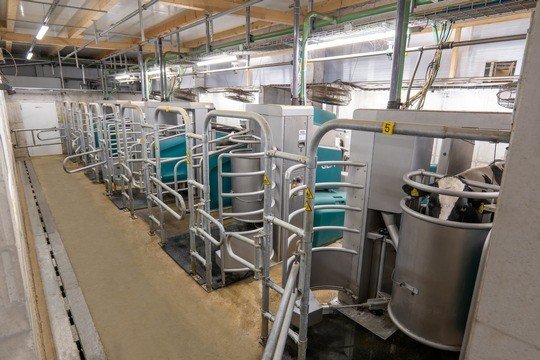
GEA is expanding its automated group milking portfolio with the DairyRobot R9600 as a semi-subway installation concept for batch milking. The solution combines fixed milking times and automated processes with a high degree of planning flexibility – both for new-build projects and for integration into existing farm and building structures. As an addition to the DairyRobot R9650 full-subway solution, GEA now offers another option for farms looking to implement batch milking for the first time or modernize existing systems.
Automated group milking for predictable processes
Batch milking refers to the automated milking of cows in groups at fixed times. Unlike voluntary milking, where cows visit the milking robot individually throughout the day, batch milking takes place within clearly defined time windows. This creates predictable routines and combines familiar herd management practices with automated milking technology.
The DairyRobot R9600 is designed for farms with medium to large herds that require predictable milking routines and clear daily structures. Fixed milking times bring structure to daily farm operations, making it easier to coordinate employees, cow groups and herd routines. Performance groups – such as high-yielding cows or animals with special needs – can also be planned in a targeted way. Clearly defined processes further simplify onboarding for new staff and support consistent training on the farm.
Semi-subway installation concept reduces construction requirements
The semi-subway installation concept reduces construction requirements compared with a full-subway solution. It uses a simplified underground structure of about one meter in depth, or an existing pit where suitable, to accommodate the milk lines. A complete basement underneath the milking boxes is not required. For farms with existing parlors or milking pits, this can make conversion easier, provided the on-site structural conditions are suitable.
Central receiver unit supports efficient operations
From a technical perspective, the DairyRobot R9600 and DairyRobot R9650 differ primarily in their structural integration and the placement of key components. Both concepts use the centralized receiver unit of the batch milking system for up to 12 milking boxes per receiver unit. With the DairyRobot R9650, the central technical units, including hygiene and disinfectant supply components, can be consolidated in the basement area beneath the robots.
The DairyRobot R9600 also uses centralized receiver technology; however, the milk lines are accommodated in a simplified underground structure, while additional peripheral equipment is housed in a separate utility room depending on system planning.
The centralized receiver unit helps consolidate technical components, makes operation and maintenance more efficient, and can reduce the consumption of water, energy and cleaning agents.
Two batch milking options for different farm concepts
With the DairyRobot R9600 and DairyRobot R9650, GEA offers two batch milking systems for different structural requirements and farm strategies. The DairyRobot R9650 is aimed at farms that want to implement a full-subway solution with excellent accessibility and centralized technology. The DairyRobot R9600 is designed as a semi-subway installation concept for farms that want to combine automated group milking with reduced construction requirements. The system is available for both new-build and existing facilities and makes it easier for conventionally milking farms to transition to automated milking. Which solution is most suitable depends on herd size, barn layout, structural options and farm strategy.
Further information on GEA’s batch milking portfolio will be available at this year’s EuroTier from November 10 to 13, 2026, in Hanover, Germany, in Hall 13, booth C25.