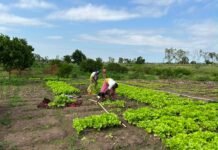



With equitable access to productive assets, finance, knowledge, technology and markets, women can produce more, build stronger businesses, create employment and contribute more effectively to household and national food and nutrition security. This is the position of NEPAD Agency.
There is a huge spotlight on the need to increase the role of women in agricultural food production in various fora organised by high-profile institutions. What sometimes lacks is clarity on the scope of women’s participation.
Estherine Lisinge-Fotabong is the Director of Director of Agriculture, Food Security and Environmental Sustainability at African Union Development Agency –(AUDA-NEPAD). As regards the role of women in agricultural production, a big distinction needs to be drawn here between mere participation and real economic engagement in agrifood systems, she points out, underlining that it is the latter that demonstrates success.
“Real economic engagement can be looked at through different parameters, such as: growth in revenue and reinvestment, ownership and control of land and productive assets; access to and repayment of formal credit; jobs created, especially for other women and young people; movement into processing, packaging, branding and export; access to formal markets and supply contracts; and representation in producer organisations, industry bodies and decision-making spaces.”
A continental benchmark
Recognising the urgency of meeting these targets, the African Union’s CAADP Kampala Declaration and the CAADP Strategy and Action Plan 2026–2035 provide an important continental benchmark. Of particular relevance is Strategic Objective 4, which is specifically focused on “Advancing Inclusivity and Equitable Livelihoods.”
The Kampala Declaration
To that effect, by the cut-off point of 2035, the Kampala Declaration has outlined vital commitments to advance the objective of inclusivity and equitable livelihoods. In this quest, the following are worth highlighting: reducing the yield gap between men and women farmers by 50% and empowering at least 30% of women, youth and vulnerable groups in agrifood value chains.
Moving beyond participation
What is very significant about these targets is that they move beyond the metric of merely counting how many women participate in programmes, stresses Lisinge-Fotabong.
“The real question we should ask ourselves is whether women have greater access to productive resources, finance, technology and markets. More importantly, whether they are gaining the economic and decision-making power to benefit from agrifood systems transformation.”
Gender, Climate Change and Agriculture Support Programme (GCCASP)
In view of this, programmes such as AUDA-NEPAD’s Gender, Climate Change and Agriculture Support Programme (GCCASP) are tailored to provide practical experience on how this can be done. They combine policy support, capacity development, women’s platforms and investment in proven approaches.
Key Performance Indicators (KPIs)
While the Kampala target is well-meaning, the challenge lies in translating its set commitments into national policies, investment plans, budgets and, finally, measurable results, acknowledges Lisinge-Fotabong.
She highlights the risk of interpreting the target of empowering at least 30% of women in agrifood value chains simply as a participation quota.
“Empowerment must mean that women have the assets, capabilities, finance, technologies, markets and decision-making power required to participate competitively and benefit economically.”
For these targets to materialise, she recommends concerted efforts in four spheres as Key Performance Indicators (KPIs). The indicators should demonstrate whether these interventions are translating into measurable improvements in women’s productivity, incomes, ownership, resilience and influence. The focus should be at four levels:
- Government level
Governments should domesticate the Kampala commitments through gender-responsive agricultural and agrifood-system policies and investment plans. Priorities should include secure land and resource rights, gender-responsive budgets, equitable access to public agricultural support, infrastructure and extension services, and stronger representation of women in decision-making.
In this regard, the government’s KPIs should encompass progress towards the Kampala target of reducing the yield gap between men and women farmers by 50%; the proportion of agricultural land and productive assets owned or controlled by women; the share of public agricultural expenditure benefiting women-led enterprises; women’s access to extension, technology and inputs; and women’s representation in agricultural institutions and decision-making bodies.
- Access to finance
There is a need for financial products that respond to the realities of women-led agribusinesses. These include, but may not be limited to, alternative collateral arrangements, blended finance, guarantees, concessional instruments and investment-readiness support.
“KPIs should track the share and value of agricultural finance reaching women-owned businesses, average loan and investment size, repayment performance, growth in women-led enterprises receiving commercial finance, and the number of women-owned businesses progressing from micro and informal operations into bankable and investable enterprises,” she elaborates.
iii. Mentorship programmes
Mentorships are very critical and, therefore, should be structured around business outcomes rather than one-off networking. This means that women should be connected to experienced agripreneurs, business leaders, technical specialists, investors and markets.
“KPIs for the mentorship programmes could include business survival and growth, revenue and productivity gains, access to new markets or finance, the number of active mentor-mentee relationships, and the proportion of mentees who subsequently mentor other women,” suggests Lisinge-Fotabong.
Persistent gaps and hindrances
Candidly, while the KPIs may indicate measurable progress, there are persistent gaps and hindrances preventing women from progressing.
Conspicuous gaps
There are conspicuous gaps in the following areas: access to and control over land, affordable finance, technology, extension services and markets.
Lisinge-Fotabong mentions a business-capability gap.
“Many women have extensive production knowledge but have had less opportunity to develop skills in areas such as costing, financial management, negotiation, contracting, standards and market development.”
Lastly, there is the data and visibility gap.
Women-led agricultural enterprises are still insufficiently represented in official data, investment pipelines and public narratives. This makes their contribution less visible.
The experience of programmes such as GCCASP shows that policy reform and capacity development must move together. Policy without implementation and capacity building has limited impact; capacity building without an enabling policy and institutional environment eventually reaches a ceiling.
The hindrances
Besides the persistent gaps, Lisinge-Fotabong cites the following as the main hindrances preventing women from excelling in areas such as commercial farming and agro-processing: lack of land tenure and asset ownership, limited networks and market access, and limited access to capital; time poverty, technology and infrastructure constraints, and social norms about what is appropriate for women.
Complicating matters is that, as these barriers are interconnected, addressing one in isolation is rarely enough. That is why the response must combine enabling policy, targeted investment, institutional support and practical capacity development, Lisinge-Fotabong reasons.
Lucrative areas for women’s involvement
While there are hindrances and gaps, Lisinge-Fotabong sees areas for more women to move into the higher-value segments of agrifood systems.
Agro-processing and value addition are particularly important because they allow producers to retain more value from what they grow.
Furthermore, there are major opportunities in cold-chain services and logistics, seed and input businesses, agricultural technology and digital services, climate-smart agriculture, export-oriented horticulture, food retail, and agricultural finance and insurance.
Generally, states Lisinge-Fotabong, the key is to move beyond viewing women primarily as small-scale producers and deliberately support them to become owners, processors, service providers, investors and leaders across the full value chain.
From a food security perspective, it is important that more women become involved in production, she emphasises.
“It is indisputable that women are already indispensable actors across Africa’s agrifood systems in production, processing, marketing, household nutrition and the management of natural resources.”
More achievement from equitable access
All things considered, with equitable access to productive assets, finance, knowledge, technology and markets, women can achieve more. They can produce more, build stronger businesses, create employment and contribute more effectively to household and national food and nutrition security.
Massive Opportunities for Young Women
Calling for a change of attitude, Lisinge-Fotabong advises young women to regard modern agriculture as an opportunity-rich sector that spans science, technology, finance, logistics, processing, trade and entrepreneurship.
She tells them to master the basics first: “Build the right skills, understand the entire value chain and learn from people already succeeding in the sector. Just as importantly, build strong networks and seek mentors who can help open doors and shorten the learning curve.”
Lisinge-Fotabong adds: “Start where you can, prove the concept and grow from there. A small enterprise that is well managed, profitable and scalable can be a stronger foundation than an ambitious plan that has not yet been tested.”
Relevant stakeholders have a central role too.
Agriculture must be presented to young women as a modern, technology-enabled and commercially viable sector, covering diverse areas such as production, processing, logistics, digital agriculture, finance, research and trade.
For this to bear fruit, Lisinge-Fotabong believes governments and partners should combine entrepreneurship education with access to land, technology, incubation, finance and markets. In this area, KPIs should include the number of young women entering agrifood entrepreneurship, the proportion establishing viable businesses within two years, business survival and growth rates, jobs created, and progress towards the Kampala commitment to empower at least 30% of youth in agrifood value chains.