

Walkabout® MOTHER BIN founder Dave Hedt’s dad quantifies why Australian growers work the way they do, and proves the right grain handling gear can change your whole harvest.
I have a cotton grower friend called Otto here in Australia who, in the last decade, has been at the forefront of a revolution in his industry.
Like grain, cotton is subject to significant quality downgrades if it’s weather damaged. So when Otto first saw the new evolution in cotton pickers — ones that operated non-stop, picking, compressing, baling, wrapping, carrying and dumping at the end of the field — he knew he was seeing a revolution in production efficiency.
In one fell swoop, that logical advance made the old and long-established practice of having a cotton boll buggy charging down a field — collecting uncompressed cotton bolls from a full, and often waiting, picker basket — unnecessary.
For those unfamiliar with the old cotton harvesting process, it roughly worked like this: the boll buggy would return to the end of the field and discharge uncompressed cotton into a 40’ x 10’ x 8′ mobile, bottomless “module builder.” That machine created a lightly compressed stack the same footprint as a semi trailer. It required three workers to fill and hydraulically compress the cotton, then move the module builder away and spread and secure a tarp to prevent weather damage. These stacks were later loaded onto a tilting “live floor” trailer and hauled to the gin.
Now here’s where it gets interesting.
At that time, Otto ran a 4,000-acre irrigated cotton operation averaging about 4 bales per acre. He used 8 standard cotton pickers, 8 boll buggies, and 16 module builders. His harvest crew was at least 40 people — five per picker — not counting cooks and the logistical joys of housing seasonal labour 50 miles from town.
Today? Otto runs 8 of those new pickers, harvests 18,000 acres at higher yields, finishes in roughly 80% of the time… and does it all with just 12 skilled staff.
That’s not an incremental gain. That’s a complete system breakthrough.
So the obvious question is: who in the corn, wheat, rice, barley or soybean industries wouldn’t want that kind of efficiency leap from their grain handling equipment?
The good news is — you don’t need to reinvent your entire harvest system or spend millions on unproven machines to get it.
Because the principle behind Otto’s transformation wasn’t really about cotton. It was about eliminating the bottleneck.
And in grain harvest, the bottleneck is almost always the same: what happens between the combine and the elevator.
Combines have never been more productive. Trucks are bigger and faster than ever. But too often, they’re all held hostage by inefficient grain handling equipment — long waits, stop-start harvesting, and lost hours when timing matters most.
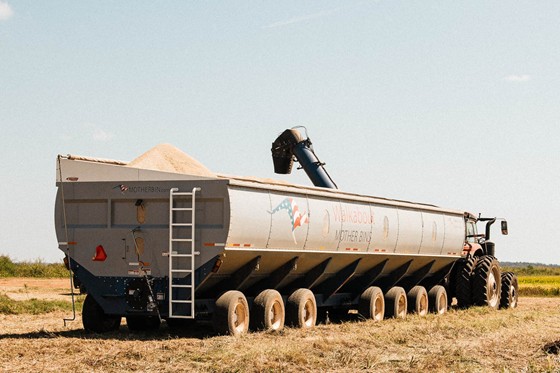
This is where slotting a Walkabout® MOTHER BIN into your grain operation changes everything.
Just like Otto’s new pickers removed the need for boll buggies and module builders, a Mother Bin removes the stop-go inefficiencies that drag down harvest performance. It creates a continuous flow system — keeping combines moving, carts turning, and trucks optimally loaded without delay.
Over the last seven years, North American growers who have identified this bottleneck and addressed it with a Mother Bin have unlocked 20–30% gains in harvest efficiency. Not by working harder, but by letting the right grain handling equipment do its job.
And unlike Otto’s leap — which required adopting expensive, foreign-built technology — this is a proven, practical step.
Walkabout® MOTHER BINS are built in the USA, backed by a strong track record across North America, and supported by 30–40 years of successful integration into Australian harvest systems.
The hardest part isn’t implementing the solution.
It’s recognizing the bottleneck.
After that light bulb moment, the rest is straightforward — and the payoff looks a lot like Otto’s story: fewer people, less stress, more acres, and a faster, more efficient harvest.
**Otto is not my cotton growing friend’s real name, but everything else in his story is factual.